
Home / La Revue Dafee/ How to Lower Cholesterol Naturally
How to Lower Cholesterol Naturally: What the Science Says

How to Lower Cholesterol Naturally: What the Science Says
What does "lowering cholesterol naturally" actually mean?
How does diet affect cholesterol naturally?
What is the role of omega-3 fatty acids in cholesterol balance?
Which plant oil provides the most ALA?
How to Lower Cholesterol Naturally: What the Science Says
Cholesterol can be supported naturally through diet, physical activity, and targeted supplementation. Among nutritional interventions, omega-3 fatty acids — specifically ALA at 2 g per day — are the only plant-based compound with a formally approved EU health claim for the maintenance of normal blood cholesterol levels.
Most people discover elevated cholesterol through a routine blood test. The number appears. The doctor mentions diet and exercise. What rarely follows is a precise answer to the question that matters most: which natural interventions actually have scientific support, and how do they work?
What does "lowering cholesterol naturally" actually mean?
Lowering cholesterol naturally means acting on one or more of four biological mechanisms: reducing hepatic cholesterol synthesis, modifying lipoprotein particle composition, influencing dietary fatty acid balance, or limiting intestinal cholesterol absorption. Most marketed supplements address none of these with sufficient evidence — a small number do.
How does diet affect cholesterol naturally?
Dietary fat composition has a direct influence on lipoprotein metabolism. Replacing saturated fatty acids with unsaturated fatty acids — particularly polyunsaturated fatty acids — is associated with changes in LDL particle concentration and composition. [SOURCE: Mensink RP et al., American Journal of Clinical Nutrition, 2003]
Soluble fibre reduces intestinal cholesterol absorption by binding bile acids in the digestive tract, prompting the liver to draw on circulating cholesterol to synthesise new bile. [SOURCE: Brown L et al., American Journal of Clinical Nutrition, 1999]
These dietary mechanisms are well-established and form the foundation of any natural approach to cholesterol management.
What is the role of omega-3 fatty acids in cholesterol balance?
Omega-3 fatty acids have one of the most well-documented relationships with lipid metabolism of any dietary compound.
Alpha-linolenic acid (ALA), the plant-based omega-3, is recognised by the European Food Safety Authority (EFSA) for contributing to the maintenance of normal blood cholesterol levels when consumed at an intake of 2 g per day. [SOURCE: EFSA Journal, 2009 — health claim on ALA and cholesterol]
This is not a marketing claim. It is a regulated health claim based on a formal review of the scientific literature by the European Union's food safety authority — one of the few cholesterol-related claims permitted under EU law.
The mechanism is not simply reducing LDL. Omega-3 fatty acids influence the fatty acid composition of lipoprotein membranes and affect the broader lipid environment, including triglyceride metabolism, where the evidence for long-chain omega-3 (EPA and DHA) is particularly strong. [SOURCE: Harris WS et al., Journal of Nutrition, 2007]
Which plant oil provides the most ALA?
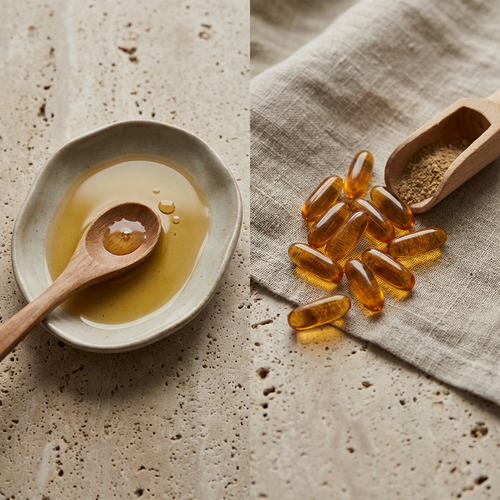
Sacha inchi oil, extracted from the seeds of Plukenetia volubilis native to the Amazon basin, contains one of the highest concentrations of ALA found in any plant oil — approximately 45–50% of its fatty acid composition.
One teaspoon (5 ml) taken straight from the spoon each day provides approximately 2 g of ALA — precisely the intake recognised by EFSA for the cholesterol maintenance claim.
Unlike fish oil, sacha inchi oil is entirely plant-based, cold-pressed, and free from the sustainability concerns associated with marine sources.
What other natural compounds have evidence for cholesterol?
Several compounds appear frequently in discussions of natural cholesterol management. The evidence varies considerably.
Plant sterols and stanols have robust evidence for reducing LDL-C by competing with cholesterol absorption in the intestine. They are among the most evidence-supported natural compounds in this category. [SOURCE: Demonty I et al., Journal of Nutrition, 2009]
Red yeast rice contains monacolin K, a compound structurally identical to lovastatin. It reduces LDL but carries the same contraindications and side effect profile as pharmaceutical statins. The European Food Safety Authority has raised safety concerns about its use in supplements. [SOURCE: EFSA Panel on Food Additives, 2018]
Berberine has shown lipid-lowering effects in several clinical trials, primarily in Chinese populations. The mechanism involves PCSK9 inhibition and LDL receptor upregulation. Evidence is promising but not yet at the level of regulatory approval in the EU. [SOURCE: Cicero AF et al., Nutrients, 2017]
Omega-3 ALA occupies a distinct position: it is the only plant-based fatty acid with a formally approved EU health claim specifically for cholesterol maintenance.
How to lower cholesterol naturally: a structured approach
The evidence points to four actionable levers:
- Replace saturated fats with unsaturated fatty acids, particularly polyunsaturated sources
- Increase soluble fibre intake through vegetables, legumes, and whole grains
- Support omega-3 intake with 2 g of ALA per day from a high-quality plant source
- Maintain regular physical activity, which supports HDL function and overall lipid balance
These are not equivalent interventions. Diet and activity form the foundation. Targeted supplementation closes specific nutritional gaps that diet alone may not fill — particularly the omega-3 deficit that characterises most modern Western diets.
Can a supplement replace diet for lowering cholesterol?
No supplement operates independently of diet, activity, and overall metabolic context. Cholesterol biology is systemic. A supplement that supports lipid balance while the rest of the dietary pattern remains pro-inflammatory provides limited benefit.
The role of a well-chosen supplement is to close a specific nutritional gap — not to substitute for broader nutritional balance.
What does a total cholesterol number fail to reveal?
A total cholesterol number alone does not reveal lipoprotein particle size, oxidative burden, triglyceride-to-HDL ratio, or ApoB concentration — the markers that add meaningful clinical information to a standard lipid panel.
Understanding your full lipid profile is the first step. Supporting it with evidence-based nutritional choices is the second.
The Dafee Lipid Intelligence app analyses your complete lipid panel, identifies your metabolic pattern, and translates it into plain language — without replacing your doctor, but giving you the interpretive framework a standard consultation rarely has time to provide.

Written by the Dafee Science Team — published 10/06/2026. Dafeepédia content is developed from European regulatory sources (EFSA, EC Regulation 432/2012) and peer-reviewed scientific literature, and reviewed for accuracy before publication.
The Dafee Metabolic Intelligence app interprets standard lipid blood panels as metabolic patterns rather than isolated thresholds — available at app.dafee.fr.