
Home / Dafeepedia / Sacha Inchi Oil Benefits for Skin
Sacha Inchi Oil Benefits for Skin — Barrier, Moisture and Lipids

What does sacha inchi oil do for the skin?
What is the skin lipid barrier and why does it matter?
What are the benefits of sacha inchi oil for the skin barrier?
What is the hidden role of essential fatty acids in skin?
What happens to skin when essential fatty acids are deficient?
How do internal nutrition and topical application differ for skin?
What does sacha inchi oil do for the skin?
Sacha inchi oil benefits the skin in two distinct ways: applied topically, it provides ALA omega-3 and linoleic acid omega-6 — the two essential fatty acids that the skin barrier is structurally made of; taken orally, its ALA content supports the fatty acid composition of cell membranes and ceramide precursor availability over time. Both mechanisms address the lipid structure that underlies skin comfort, moisture retention, and barrier integrity.
Dry skin is rarely a surface problem. It is a structural one. The skin barrier — the stratum corneum — is a lipid architecture built from ceramides, free fatty acids, and cholesterol. When the lipid matrix is intact, skin retains moisture and resists external aggressors. When it is depleted, water escapes, sensitivity rises, and no amount of water-based hydration can compensate — because water does not replace lipids.
What is the skin lipid barrier and why does it matter?
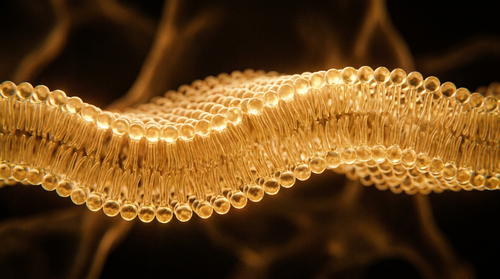
The skin lipid barrier is the outermost layer of the skin — the stratum corneum — composed of dead skin cells (corneocytes) embedded in a lipid matrix of approximately 50% ceramides, 25% cutaneous cholesterol, and 15% free fatty acids. This lamellar structure retains transepidermal water and prevents external irritants from penetrating the skin.
Two essential fatty acids are required for this structure: ALA (alpha-linolenic acid, omega-3) and linoleic acid (omega-6). Both are direct precursors to skin ceramides. Neither can be synthesised by the body — they must be supplied through diet or topical application. When they are insufficient, ceramide production declines, the lipid matrix weakens, and transepidermal water loss (TEWL) increases.
What are the benefits of sacha inchi oil for the skin barrier?
Sacha inchi oil reinforces the skin lipid barrier by supplying the two essential fatty acids — ALA and linoleic acid — that the stratum corneum requires for ceramide synthesis and lipid matrix integrity. Applied topically, these fatty acids penetrate the stratum corneum and serve as substrates for barrier repair. The oil's natural tocopherol (vitamin E) content provides antioxidant protection and contributes to formulation stability.
A review published in Skin Pharmacology and Physiology confirmed that polyunsaturated omega-3 fatty acids play a structural role in cutaneous keratinocyte membranes and influence the lipid composition of the stratum corneum. A 2026 systematic review published in Discover Food (Springer Nature) noted that pre-treatment of skin tissue with sacha inchi oil before UV irradiation did not provoke excessive cytokine secretion — indicating the oil supports rather than disrupts barrier function.
The combination of ALA and linoleic acid in a single oil is particularly relevant for the skin barrier, which requires both omega-3 and omega-6 simultaneously. Sacha inchi oil contains approximately 48% ALA and 35% linoleic acid — one of the highest combined concentrations available in any plant oil.
What is the hidden role of essential fatty acids in skin?
Essential fatty acids are incorporated into the phospholipid bilayer of every skin cell membrane, where they regulate membrane fluidity, permeability, and cellular signalling. They are also the biochemical precursors to skin ceramides — the primary structural lipid of the stratum corneum.
Because the body cannot synthesise ALA or linoleic acid independently, their availability directly determines the lipid composition of the skin. A chronic deficit — which in modern diets is more often a relative imbalance than an absolute deficiency — reduces ceramide synthesis efficiency, increases TEWL, and compromises barrier resilience over time.
This is the mechanism that connects nutrition to skin comfort: not through hydration, but through lipid structure.
What happens to skin when essential fatty acids are deficient?
Essential fatty acids are incorporated into the phospholipid bilayer of every skin cell membrane, where they regulate membrane fluidity, permeability, and cellular signalling. They are also the biochemical precursors to skin ceramides — the primary structural lipid of the stratum corneum.
Because the body cannot synthesise ALA or linoleic acid independently, their availability directly determines the lipid composition of the skin. A chronic deficit — which in modern diets is more often a relative imbalance than an absolute deficiency — reduces ceramide synthesis efficiency, increases TEWL, and compromises barrier resilience over time.
This is the mechanism that connects nutrition to skin comfort: not through hydration, but through lipid structure.
How do internal nutrition and topical application differ for skin?
Dietary omega-3 and topical application address skin health through different mechanisms at different timescales.
Topical application delivers ALA and linoleic acid directly to the stratum corneum, where they are available immediately as substrates for barrier repair. The effect is local and relatively rapid — supporting the lipid matrix from the outside in.
Dietary intake influences the fatty acid composition of cell membrane phospholipids throughout the body, including the skin. This systemic effect builds gradually over weeks and months, as the membrane lipid profile shifts in response to sustained dietary intake.
Neither mechanism substitutes for the other. Topical application repairs the barrier surface; dietary intake supports the cellular environment that produces and maintains it.
How should sacha inchi oil be applied to the skin?
Sacha inchi oil is best applied to clean, slightly damp skin — immediately after cleansing, before water evaporates from the surface. A few drops warmed between the fingers, pressed gently onto the face and neck, allows the oil to absorb without residue.
Applying to damp skin is not incidental — it creates an occlusive effect that traps moisture within the stratum corneum while the oil's fatty acids penetrate and support the lipid matrix. Applying to completely dry skin reduces this effect.
Sacha inchi oil should not be heated above 40°C. Its polyunsaturated fatty acids — particularly ALA — are sensitive to heat, light, and oxidation. Store in a dark, airtight glass bottle away from direct light.
What is a balanced approach to omega-3 and skin health?
A complete approach to omega-3 and skin health combines adequate dietary ALA intake with topical application of essential fatty acid-rich oils. Sacha inchi oil — with approximately 48% ALA and 35% linoleic acid — provides both essential fatty acids simultaneously in a single ingredient, applicable both internally and externally.
Orally, 5ml of sacha inchi oil per day provides approximately 2.4g of ALA — meeting the EFSA threshold for the authorised health claim that ALA contributes to the maintenance of normal blood cholesterol levels (EU Regulation 432/2012), while simultaneously supporting the systemic fatty acid pool that the skin draws from for ceramide synthesis.
Topically, a few drops applied to damp skin after cleansing supply ALA and linoleic acid directly to the stratum corneum — the barrier that hot water, alkaline soaps, sleep deprivation, and hormonal change all systematically degrade.
One ingredient. Two routes. One shared lipid biology.


Written by the Dafee Science Team — published 17/02/2026. Dafeepédia content is developed from European regulatory sources (EFSA, EC Regulation 432/2012) and peer-reviewed scientific literature, and reviewed for accuracy before publication.
Dafee's two-product ritual — Daily-Feed (internal) and Daily-Feel (topical) — is designed around this dual-pathway approach to skin barrier support. Discover daily-feel